Thursday, August 9th 2012

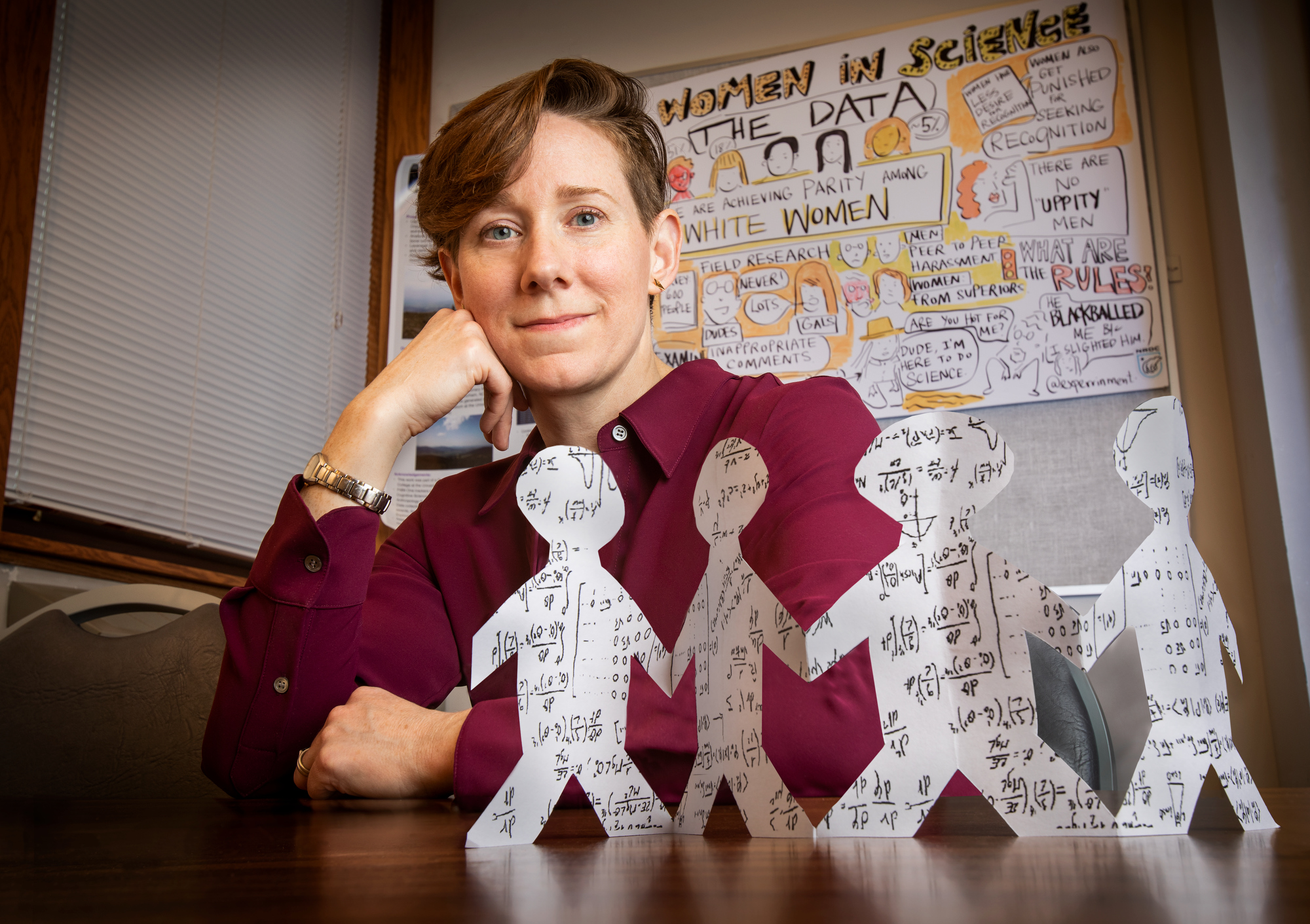
My daughter, who just this morning declared "I want to be a scientist like mama and an engineer like dada!" Role models may help keep impostor syndrome at bay.
Not an impostor
I think I started blogging because of impostor syndrome. Impostor syndrome, for those unfamiliar with the term, is when an individual feels she doesn’t belong or deserve her accomplishments. This can come from external or internal factors, and really, the internal factors are by definition largely derived from the external ones.
A person can have experiences that directly lead her to feel like an impostor, such as repeated remarks about her age, probing questions into her expertise despite a strong technical background, or jokes about a woman’s science capabilities. She can be reminded that she is no more than an object to some, by reading about studies showing women’s bodies are interpreted as objects but men’s as people. And a person can internalize these experiences and feel less competent, such as when she second guesses her invitation to an elite science conference, to a major blog network, or to a tenure-track position *cough not me cough*. This second-guessing based on stereotype threat can actually lead to, in the case of gendered impostor syndrome, women actually sounding less competent than men, but only when communicating with men about their science.
So, I was saying how my blogging came out of impostor syndrome. My confidence lies in teaching and outreach (notice I didn’t say my strengths, more on this shortly). And I have a tendency to throw myself into activities where I am confident so that I don’t have to deal with the feelings of, well, un-confidence. So against the general advice given to tenure-track faculty at research-intensive institutions I immediately got involved in a major teaching and service initiative that has drained a lot of my time and effort, and I started to blog. Now, teaching, service and outreach are activities that faculty should devote a lot of time to. And all of this work has actually had a positive ripple effect on my research in terms of building relationships in my community, university, and discipline, building a name for myself as an innovative teacher, improving my writing skills and general anthropology knowledge, and emboldening me to pursue a more biocultural research focus. But it’s unclear to me whether these ripples were worth the huge whirlpool of lost time that could have gone to writing manuscripts and proposals.
Am I living a life I can be proud of? Most certainly. Am I pursuing teaching, research, service and outreach projects I deem important? Absolutely. Have I organized my time in such a way as maximizes my case for tenure?
No. No, I have not.
And this different budgeting of my time – a product of feeling like an impostor in my job and actually thinking the stuff I do is important – is what has been on my mind lately. The question is, how does one be a faculty member that does what is right while not shying away from the work that earns you research accolades, publications, grants and tenure? To be clear, being a faculty member that does what is right, by my personal standards at least, is one that is strong in research as well as teaching, service and outreach. This might differ from a tenure committee that emphasizes a focus on research accomplishments, but not by much.
Here’s the thing: I think my research kind of rocks. Let me try and state this again without the typical, gendered equivocating: my research rocks. I don’t think it’s the kind of research that Nature or Science will ever value (haha, except that this is a Nature Publishing Group-funded blog!), I don’t think Natalie Angier will ever knock down my door to interview me among a legion of my grad students and postdocs in a fancy, center-funded laboratory. But I think that the questions I ask, the way I frame my research, and the evidence I have gathered is going to have a lasting, meaningful impact on my field and, I hope, on clinical women’s health research. I have a perspective that could radicalize our understanding of human reproductive ecology, and project ideas and upcoming pilots that will test whether this is the case.
Imagine if I could stop being chicken enough to confront the feeling that I am a less competent researcher. Imagine if I could finally really be the scientist I know I can be. Because I love you all, and science writing is a valuable part of my life, but I am a scientist first and blogger second.
It was with these thoughts swirling in my head, and with my making some serious progress this summer in this direction, that I went to Sci Foo last weekend.
Whoa, I know Sci Foo
Sci Foo, for those not in the know (which was me before about 5pm Friday the 3rd) is a science unconference put on by O’Reilly group (hence Foo, Friends Of O’Reilly), Google, and Nature Publishing Group. The selection process for, and purpose of, this invite-only conference is opaque. And the unconference style, which selects for bold personalities unafraid to run sessions that they make up on the spot, can compound this problem for those of an impostor-y inclination. What do I have to contribute? Why am I here? I don’t know what to run a session on, but if I don’t run a session, will I not get invited back?
I say this not to lay blame on the Sci Foo format – I enjoyed myself immensely and think there is a lot to be gained by disrupting the traditional conference structure. And the conference organizers deserve major props for putting some safeguards in place to circumvent impostor syndrome or more quiet personalities: there was a planning wiki for people to offer session ideas ahead of time, and empty spaces left open intentionally so people who didn’t want to submit a session on the first night had a chance to think and maybe contribute later in the conference.
But it did not help that the conference was overwhelmingly male and white, more than any conference I have ever attended. I don’t think I was the only one wondering why it was a total dude-fest, and the sex ratio put me on the defensive as soon as I got on the first shuttle from the hotel to the Googleplex. This lessened by the end of the first full day, because over the course of my experience of Sci Foo I was met with nothing but kindness, excitement and collegiality. But I had to check my attitude again and again, and remind myself that I was not a token, to engage fully in conversations.
The culture of science
Somehow, I think by goading each other into it, Christina Agapakis, Sally Otto and I co-led a session in the very first slot on Saturday morning on impostor syndrome and the culture of science. Christina Agapakis came up with the idea and is a synthetic biology post-doc, fellow SciAm blogger, and has written her own fantastic post on the session; Sally Otto is a biology professor who performs mathematical models to test cool hypotheses about evolution and is a MacArthur genius grant-winner (I know!!!). We wanted to think about the culture of science that pushes many people out, and then makes many of those who remain feel like impostors.
When we first showed up to the room, there were a few young women already present, and so I figured the session would go as we predicted: we gain power from recognizing our fears, put some thought into changing the culture, and go forward supporting each other and trying to take up space in the conference. But suddenly a bunch of men – older, accomplished men – showed up. Then the gender ratio was closer to 50-50, better than the conference but still not what we expected.
I couldn’t figure out why they were there. Were they allies? Were they there to troll the session? We introduced the session and then had every single participant discuss what the term meant to them and briefly describe an experience they had where they felt like an impostor. It was important to us, even though it took most of the session, to make sure everyone got to speak once.
As it turns out, the women in the room were there for exactly the reason we designed the session in the first place: to think about our impostor feelings, confront them, and move on from them to have a productive conference. The men in the room were there for a few different reasons, none of them bad, all of them interesting. Some men were there to be allies, some were there because they had no idea what the term impostor syndrome was and wanted to find out, and some were there because they wanted to discuss their definition of impostor syndrome, which was the existence of scientists who act like they know what they’re talking about but are really impostors (these folks were very vehement and wanted to figure out how to annihilate these people).
And some men felt like impostors sometimes, too.
I think the session was educational for everyone. Those of us familiar with the traditional usage of the term introduced a level of sensitivity to the topic, and discussed ways to produce successful strategies for surviving and thriving in the academic climate. Those who had achieved some level of fame and developed a sense of being an impostor afterwards (which was very interesting, and shared by several prominent people in the room) had some lighthearted and thoughtful ways to deal with it. And we all took solace in the ideal version of science, which delights in ideas, uncertainty, and sometimes being wrong.
A few points that we discussed are worth highlighting:
- The culture of science often privileges perceived legitimacy from attitude and pedigree over actual ability. This is counter to the ideal culture of science I mention above, and makes it difficult for scientists to become interdisciplinary.
- We should be more open about ignorance, uncertainty, and knowing what we know versus what we don’t know. Again, this is appreciated in many places across science even while directly opposing behaviors are rewarded.
- We need to differentiate between authority and expertise. Some worried that the democratization of science actually empowers people who speak with more authority rather than those who are best at their science.
What struck me by the end of the session is that impostor syndrome is universal. The folks who wanted to demolish impostors and the folks who wanted to stop feeling like an impostor are on either side of the same coin. People who are less of an authority than they think they are, and people (mostly women and people of color) who are more of an authority than they think or are treated, are a result of issues in the culture of science, which includes universal issues of sexism and racism.
What we didn’t have time for was a discussion about how to move forward from here. What will it take to move towards an impostor-free culture of science?
Tuesday, July 31st 2012
Thursday 26th July saw the launch of SciLogs.com, a new English language science blog network. SciLogs.com, the brand-new home for Nature Network bloggers, forms part of the SciLogs international collection of blogs which already exist in German, Spanish and Dutch. To celebrate this addition to the NPG science blogging family, some of the NPG blogs are publishing posts focusing on “Beginnings”.
Participating in this cross-network blogging festival is nature.com’s Soapbox Science blog, Scitable’s Student Voices blog and bloggers from SciLogs.com, SciLogs.de, Scitable and Scientific American’s Blog Network. Join us as we explore the diverse interpretations of beginnings – from scientific examples such as stem cells to first time experiences such as publishing your first paper. You can also follow and contribute to the conversations on social media by using the #BeginScights hashtag.
Over the course of my training to become a biological anthropologist with a specialty in women’s reproductive ecology and life history theory, or ladybusiness expert , I have learned a lot about miscarriage. Only it wasn’t miscarriage, it was spontaneous abortion. Except that some didn’t like the term spontaneous abortion and used intrauterine mortality (Wood, 1994). Or fetal loss. Fetal loss is probably the most common.
There is also pregnancy loss (Holman and Wood, 2001). You can use that term, too. Oh, or a-conceptions (a for abortion), compared to l-conceptions (l for live birth) (Wood, 1994).
A large number of these fetal losses are before or close to the time of implantation. For many of those, unless the mother is measuring her hCG levels via a pregnancy test because she’s trying (or not) to get pregnant, she is at most going to notice a day or two longer cycle, maybe a slightly longer but lighter period. Most women with very early fetal loss will never even know they were pregnant.
So fetal loss, while important to my research, never seemed like a big deal to me from a cultural or emotional perspective. And there are a lot of ways to talk about it, plenty of terms to choose from.
They’re all inadequate.
* * *
The first time I talked to someone about her miscarriage was only a week or two after she told me she was pregnant. “I know the convention is to wait twelve weeks, but it seems silly to keep it a secret that long.” I was maybe twenty five, still uninterested in children enough to be perplexed that she wanted one, but thrilled for her. We hugged over the stick shift of her car.
Then, later, she shares that the fetus hadn’t grown since the last ultrasound, and almost certainly was dead. We hug again, and I don’t know what to say. I never found out if she had to get a D&C or whether she miscarried on her own. A few days later, we’re in an important meeting in a local cafe. She hasn’t gotten some key things done. I don’t know what to do: is the right thing to do to push her and act like nothing’s happened, or give her time to grieve? Asshole that I was, I ask her about her piece of the work.
She pauses. “I just feel… lost.”
And she begins to cry.
The third person in our meeting, our boss and friend, says, “We are not pushing a woman who just had a miscarriage.” And so the three of us just sat in that cafe, in the uncomfortable semi-silence of trying to hold back tears. And none of us knew what to do next.
* * *
A few years later, I found myself a very different person, no longer remotely perplexed by the idea of wanting a child. I loved the smell and feel of babies. I wanted to carry a baby in my belly. And thankfully, after a little help, I was pregnant.
Shortly after implantation, I had about a week of almost continuous menstrual cramps. I felt as though I would get my period at any moment, and spent almost every day semi-working from home, in a panic that I was about to miscarry. In a follow-up call with my nurse, she told me the cramping was actually normal in a healthy pregnancy and that my hCG concentrations – that’s the signal the fetus sends to the mother to let her know it’s there – were quite high. For about the millionth time that week, I sobbed like a baby.
For the rest of that first trimester I was so nauseous that I could barely eat. I lost six pounds, unheard of for a big eater like me. Yet as awful as I felt, I relished every second of that nausea, because I knew it meant the fetus was most likely alive and thriving.
As far as I know, I have never miscarried.
Miscarriage still terrifies me.
* * *
There was the woman who was having twins, until one stopped growing. There was the one who didn’t tell anyone until she was twenty weeks into her next pregnancy for fear of jinxing the one that seemed to be sticking. There are the ones where the woman shrugs it off, where tears prick at the corners of her eyes, where the shoulders slump even as she tries to smile.
The beginning of pregnancy, which if you want to be pregnant is a joyous moment, is also fraught with tension. Most of the advice newly pregnant women receive is about denial: no caffeine, no alcohol, no raw fish or raw milk or tuna or swordfish or deli meat or unwashed fruits or vegetables. No cleaning kitty litter. Don’t let your heart rate get too high. No heavy lifting. Don’t gain too much weight, or too little.
And don’t stress out, of course. It can hurt the baby.
The majority of factors that influence fetal loss are likely out of the mother’s control, meaning they have little to do with any of the above factors. Genetic abnormalities comprise the majority of very early fetal losses, as far as we can tell. These are embryos that probably would not develop properly into fetuses. When this happens, the body can reject an ill-formed embryo, or the embryo itself simply fails to grow. But this is a mechanism we know very little about.
Maternal age also matters, as the risk for fetal loss increases with age (more so after thirty-five years). There are at least three factors contributing to this: the eggs, the ovaries, and the endometrium. Aging eggs probably contribute to the genetic abnormality issue. And aging ovaries and an aging endometrium could have an increasingly hard time supporting a fetus, and so lower hormones or a thinner or less-nourished endometrium could help explain some fetal losses (there’s a lot more I could say on this, so let’s just assume I’ll elaborate in a future post). For instance, low progesterone concentrations, which is the hormone the ovary and then placenta secretes to maintain pregnancy, is associated with miscarriage risk (Arck et al., 2008). After thirty, progesterone concentrations begin to decline, but are still in the peak range through about thirty five years of age (Ellison et al., 1993; O’Rourke et al., 1996). Another study found that maternal age decreases the chance of conception, but donor’s age increased the risk of miscarriage in women undergoing IVF (Levran et al., 1991). These are women who are undergoing progesterone supplementation, so my best guess is that their endometria become less responsive to hormonal control as they age (Clancy, 2009). Yet, a mother cannot control her own age and can only partially control her chances of getting pregnant.

Figure 1. The straight line represents the increase in the number of fetal losses over a woman's lifetime, the curved line her ovarian hormone concentrations.
The controllable factors still probably have little to do with all the things a pregnant woman is supposed to avoid during pregnancy. Across a few clinical samples, researchers have found that spontaneously conceiving, underweight women are at a greater risk for miscarriage (Arck et al., 2008), overweight and obese women are not (Turner et al., 2010), but obese women with recurrent (three or more) miscarriages are (Metwally et al., 2010) and overweight women conceiving with IVF are as well (Dokras et al., 2006). There is a sweet spot that reduces risk the most in terms of maternal weight. Yet weight is a potent mix of genetics, socioeconomic status, and nutritional status that rests on top of the supposed biggest culprit of willpower.
Of all the things a pregnant woman is supposed to avoid, stress is the one with a growing body of evidence in its favor. One prospective study – meaning they began to study participants before they were pregnant – found that women from a rural Mayan sample who experienced very early fetal loss had higher cortisol concentrations (Nepomnaschy et al., 2006, who happens to be a collaborator on a different project). Cortisol is often mistakenly called a “stress hormone” in our popular interpretation of psychological stress. But cortisol is a signal of physiological, or constitutional stress. It indicates that our hypothalamic-pituitary-adrenal axis has been activated, which means the body is at minimum trying to allocate towards maintenance effort or the stress response. So this study – one of the first of its kind and, I think, performed to a high technical standard – shows us that freeliving women who happen to have miscarriages also happen to have an elevated stress response. Whether that is causal is unclear.

Fig. 2. From Nepomnaschy et al 2006.
In efforts to get at stress from a different angle, some researchers have explored inflammation, which I review in a chapter in Building Babies, out in September (Clancy, 2012). Systemic inflammation, often measured via C-reactive protein (CRP), is correlated with psychological stress (Danese et al., 2009; Miller et al., 2005; Miller et al., 2002). And there are indicators that both systemic and local inflammation impact pregnancy. But here’s the funny thing: you actually need some inflammation to support pregnancy. So very high and very low concentrations of CRP are both correlated with an increased risk of early fetal loss (Sacks et al., 2004). There’s that sweet spot again.
To make it all extra confusing, many of these studies employ different methods to understand fetal loss. Prospective or retrospective study designs, different ways of determining pregnancy, different cutoffs for what constitutes early fetal loss, very early fetal loss, and so on. So actual estimates of how much these factors influence fetal loss varies. The safest overall estimate for any given pregnancy is probably about 30%, though one study, even with conservative estimates of pregnancy and fetal loss puts it at 60% (Holman and Wood, 2001). This means, though, that for every two live births a woman has, she’ll have at least one miscarriage. And that’s not because she’s done anything in particular to deserve it.
The randomness, the lack of control, the fact that it can even happen a few times in a row in a woman and just be poor luck, that is the terror of miscarriage. Trying to give it a different name, or restricting women’s intake or movements, these are just ways to try and establish control in something largely uncontrollable.
So, beginnings are wonderful. But beginnings can be brutal, too. And there are no words I can say that will make the experience of miscarriage less raw or inexplicable.
References
Arck PC, Rücke M, Rose M, Szekeres-Bartho J, Douglas AJ, Pritsch M, Blois SM, Pincus MK, Bärenstrauch N, Dudenhausen JW. 2008. Early risk factors for miscarriage: a prospective cohort study in pregnant women. Reproductive biomedicine online 17(1):101-113.
Clancy KB. 2012. Inflammation, reproduction, and the Goldilocks Principle. In: Clancy KB, Hinde K, Rutherford JR, editors. Building Babies: Primate Development in Proximate and Ultimate Perspective. New York: Springer.
Clancy KBH. 2009. Reproductive ecology and the endometrium: physiology, variation, and new hypotheses. Yearbook of Physical Anthropology 52:137-154.
Danese A, Moffitt TE, Harrington H, Milne BJ, Polanczyk G, Pariante CM, Poulton R, Caspi A. 2009. Adverse Childhood Experiences and Adult Risk Factors for Age-Related Disease: Depression, Inflammation, and Clustering of Metabolic Risk Markers. Arch Pediatr Adolesc Med 163(12):1135-1143.
Dokras A, Baredziak L, Blaine J, Syrop C, VanVoorhis BJ, Sparks A. 2006. Obstetric outcomes after in vitro fertilization in obese and morbidly obese women. Obstetrics & Gynecology 108(1):61.
Ellison PT, Panter-Brick C, Lipson SF, O’Rourke MT. 1993. The ecological context of human ovarian function. Human Reproduction 8(12):2248-2258.
Holman D, Wood J. 2001. Pregnancy loss and fecundability in women. In: Ellison P, editor. Reproductive Ecology and Human Evolution. New York: Aldine de Gruyter.
Levran D, Ben-Shlomo I, Dor J, Ben-Rafael Z, Nebel L, Mashiach S. 1991. Aging of endometrium and oocytes: observations on conception and abortion rates in an egg donation model. Fertil Steril 56(6):1091-1094.
Metwally M, Saravelos SH, Ledger WL, Li TC. 2010. Body mass index and risk of miscarriage in women with recurrent miscarriage. Fertility and Sterility 94(1):290-295.
Miller GE, Rohleder N, Stetler C, Kirschbaum C. 2005. Clinical depression and regulation of the inflammatory response during acute stress. Psychosomatic medicine 67(5):679-687.
Miller GE, Stetler CA, Carney RM, Freedland KE, Banks WA. 2002. Clinical depression and inflammatory risk markers for coronary heart disease. The American Journal of Cardiology 90(12):1279-1283.
Nepomnaschy P, Welch K, McConnell D, Low B, Strassmann B, England B. 2006. Cortisol levels and very early pregnancy loss in humans. Proceedings of the National Academy of Sciences 103(10):3938-3942.
O’Rourke MT, Lipson SF, Ellison PT. 1996. Ovarian function in the latter half of the reproductive lifespan. American Journal of Human Biology 8(6):751-759.
Sacks GP, Seyani L, Lavery S, Trew G. 2004. Maternal C-reactive protein levels are raised at 4 weeks gestation. Hum Reprod 19(4):1025-1030.
Turner MJ, Fattah C, O’Connor N, Farah N, Kennelly M, Stuart B. 2010. Body Mass Index and spontaneous miscarriage. Eur J Obstet Gynecol Reprod Biol 151(2):168-170.
Wood JW. 1994. Dynamics of Human Reproduction: Biology, Biometry, Demography. Hrdy SB, editor. Hawthorne, NY: Aldine de Gruyter.
Thursday, July 26th 2012
Yesterday:
- I submitted an NSF CAREER proposal on the reproductive ecology and life history of peri-menarcheal girls
- I submitted a manuscript on transvaginal ultrasounds and stress to a gynecology journal, and
- I submitted an IRB (Human Subjects Committee) proposal.
Since I may never be that productive in a single day ever again, I figured I would catch up on some of my reading.
Summer reading
This summer has been the Summer of Connie Willis. After reading Doomsday Book a year or so ago (heartbreaking, beautiful, a necessary part of your life), and then one of her short story collections Impossible Things, I temporarily forgot about her (to be fair, I was reading Kristin Cashore and George R. R. Martin). Then this summer I’ve read Lincoln’s Dreams, To Say Nothing of the Dog, and yesterday finished The Passage. The Passage may be my favorite yet, the most unexpected, scary, sad, re-emergent book I’ve read in a while. It was a challenging read because it put me in a morbid state of mind, which is something I already found myself in after my birthday, which was last week (this has to do with me worrying about how long I will be able to play high-level roller derby before someone hands me a cane and kicks me off the rink). But Willis has proven herself to be one of the handful of writers of adult science fiction that writes the kind of difficult but beautiful, hopeful even as it’s terrifying novels that will ensure that I read every single short story, novella and novel she writes.
But, what do I read in between all the Willis novels and collections? Fellow professor and derby athlete Steph Davidson (well, I call her Snarker Posey) recommended some great young adult fiction, as I am a fellow lover of all things YA: Divergent by Veronica Roth (I’ve just started), Unwind by Neal Shusterman, and Emergence by David R. Palmer. I’ll be taking these to California for some family time and Sci Foo.
Other books I am considering: Barbara King’s science-y summer read recommendations, and Alyssa Rosenberg’s vote for Alif the Unseen.
Not novels, but other things worth a read:
Academia
The “snake fight” portion of your thesis defense (I believe I have a faculty meeting next month to incorporate this into our graduate curriculum.)
Notes from the #ProfGrind: Having it all (the remix)
Dual Career Challenges
Has Higher Education Become an Engine of Inequality?
Becoming a “Stylish” Writer
Thoughtful, kick-ass science writing
How bacteria in the vagina change during pregnancy
The Life Engineers: Prometheus Asks, Is a Culture as Stupid as Ours Ready to Create New Life?
Written in Stone, one year later
Are warnings about the side effects of drugs making us sick?
One Molecule for Love, Morality, and Prosperity? Why the hype about oxytocin is dumb and dangerous. This might be one of my favorite pieces by Ed Yong ever. Ed identifies exactly what has infuriated most people I know who study behavioral endocrinology about oxytocin fever, and does it with confidence and care.
Some LOLs
Barber Lab Quartet – The Longest Time (Coral Triangle Edition) (maybe not bringing the LOLs, exactly, but they sure are bringing the adorable, and sharing very cool science to boot)
36 Terrible Sex Tips for Men (maybe NSFW, but also rather hilarious)
Always Label Your Axes
What are you reading this summer?